
As part of post-acquisition integration, the manufacturer faced several operational and infrastructure risks.
Fragmented Infrastructure
IT assets were split across an existing Azure Tenant and VMware, creating management complexity.
Lack of Platform Alignment
The application operated outside the acquiring company’s Azure standards. Backup, patching, monitoring, and security controls were inconsistent with corporate IT policies.
Elevated Workload Risks
SQL Server Standard and local print services linked to a cloud-ERP represented elevated disruption risk during migration and cutover.
No Dev/Test Environment
The manufacturer required coordinated production cutovers with no staging environment available, making pre-migration validation critical.
The manufacturer partnered with Lunavi to consolidate infrastructure into Microsoft Azure using a lift-and-shift approach. Lunavi executed a structured migration from both existing Azure tenants and VMware into a new spoke subscription in the East US region, following a structured milestone approach.
Lunavi's process included the following:
Discovery & Readiness Assessment
Evaluated VMs, workload dependencies, & network requirements across VMware & existing Azure source environments.
Spoke Subscription Provisioning
Built Azure spoke with DMZ configuration, firewall & connectivity rules, access controls & governance baselines.
Workload Transition & Validation
Migrated all VMs using Azure Migrate, performed offline testing, rollback validation, & coordinated production cutovers.
Disaster Recovery
Configured Azure Site Recovery (ASR) for production workloads with failover validation & documented DR runbooks.
AIM & Managed SIEM Onboarding
Migrated workloads onboarded to Lunavi’s Azure Infrastructure Management & Managed SIEM services.
Key Azure Services
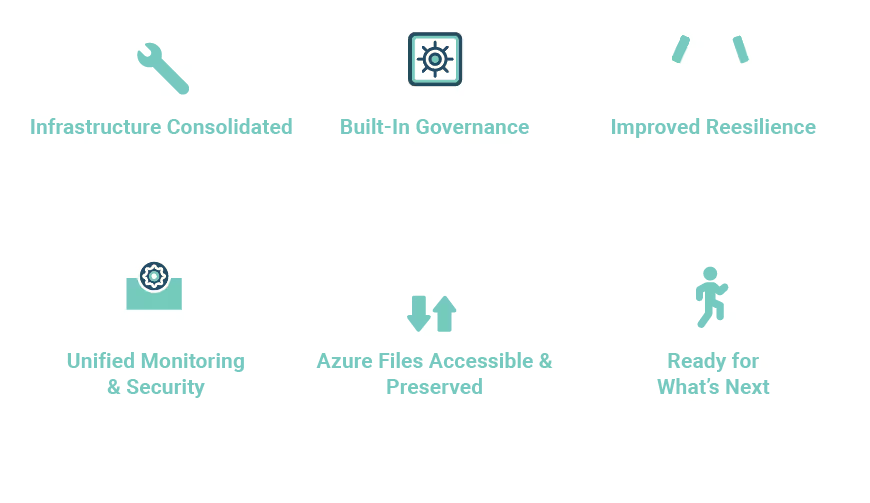
By consolidating the new acquisitions infrastructure into the current Azure environment, the Industrial Manufacturer eliminated the complexity of managing assets across multiple Azure tenants and VMware systems. The lift-and-shift approach preserved all workload functionality while bringing operations under standardized governance and security controls.
With Azure Site Recovery configured and all workloads onboarded to Lunavi’s AIM and Managed SIEM services, the organization now has consolidated visibility and operational continuity. The Azure spoke provides a scalable foundation for ongoing management and future modernization of the acquired environment.
.png)
Navigate what's next.