Introducing AIaaS: Maintaining Effective AI Agents

February 24, 2026
Generative AI has quickly moved from conversations that are useful for drafting, summarizing, and brainstorming content to being able to “think through” complex, multi-step problems. Today, Intelligent Applications and AI Agents are where enterprises can unlock real value. AI Agents are your digital workforce that can turn everyone into an expert, take action and automate workflows, and even operate independently, dynamically plan, orchestrate with other agents, and escalate to humans. Intelligent Applications add improved efficiency and user experiences within your existing line of business applications.
Many organizations are moving quickly to adopt generative AI into their applications and automate workflows. They have moved past the proof of value phase and are deploying these solutions into production for their internal users and customers. Operationalizing these systems in production are different than traditional applications and even Machine Learning based AI solutions.
Traditional applications are deterministic. Given the same input, they return the same output. The logic is defined in advance, and behavior remains predictable until someone changes the code.
Generative AI systems are probabilistic. Responses are generated based on patterns and likelihoods, which means outputs can vary depending on phrasing, context, and prior interactions. That flexibility is what makes generative AI useful for solving a variety of functionality for summarizing content, answering complex questions, and assisting with open-ended tasks.
Therefore generative AI systems need to be managed differently in production to ensure they stay on the rails and continue to operate cost, accuracy, and securely effectively.
This isn’t about single AI application or handful of agents, organizations will start to quickly scale AI workloads to 100’s and 1000’s of agents. IDC predicts there will be 1.3 billion agents by 2028.
What Changes After Go-Live
Before launch, teams validate AI against known use cases. They test accuracy, establish guardrails, and confirm tone and data boundaries.
After launch, real users introduce new scenarios. They ask questions that were not part of the original validation set. They test edge cases. Usage expands into areas that were not anticipated.
To give you an idea what this means, a couple years ago, we were building a banking assistant for a credit union that we validated it could do several combinations and variations of account transfers and look ups. In the demo to our client, our CSM suggested we ask it “How much money could I save if I quit going out to eat?”. I knew not only was this not a test case, but it wasn’t anything we thought about. After holding my breath while our team typed in the question and asked it, it correctly responded with a list of charges in the account that were restaurants, totaled them up, and provided a great answer.
These are the types of things generative AI is great at. But once it is in production, how do we ensure that it provides accurate answers? How do we ensure someone isn’t trying to circumvent the security and safety controls? And how do we provide a way to keep the costs from spiraling out of control?
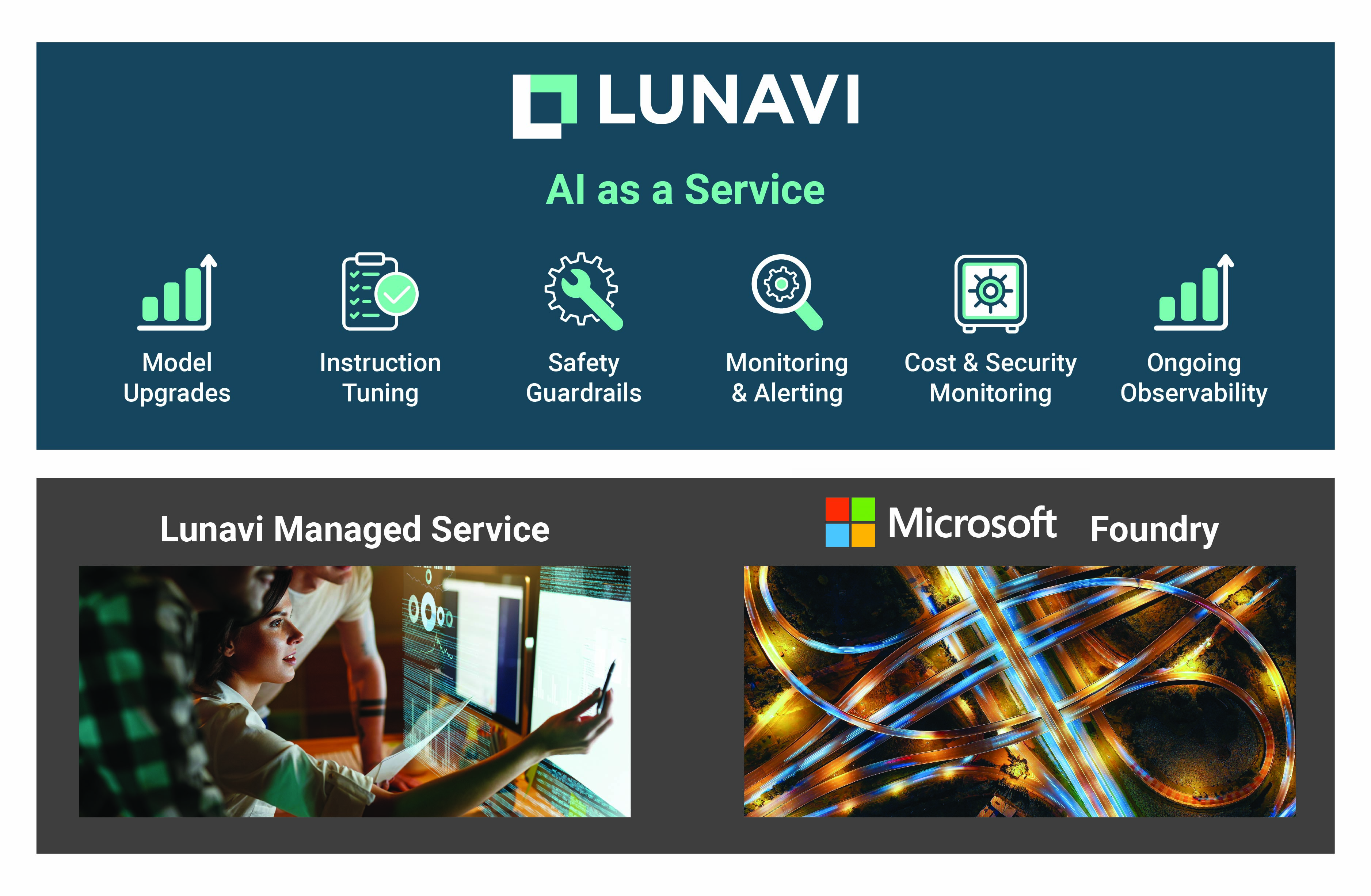
Lunavi AI as a Service
Lunavi’s AI as a Service was created out of the needs of our customers and our own AI solutions that we have built. AI as a Service combines our expert 24x7 Azure monitoring and managed services operations along with the instrumentation and monitoring to provide around the clock peace of mind to ensure accuracy, security, and cost stays consistent and valuable. Furthermore, ongoing care and feeding of the AI application and agents is handled through monthly alignment checks and yearly model updates.
Most importantly, this allows us to stay in lock step with you as additional systems and agents are built on this foundation.
AI as an Operational Capability
Executive leaders are focused on outcomes. They want increased productivity, reduced manual workload, predictable spending, and controlled risk.
Those outcomes depend on treating AI as an operational capability rather than a one-time project. AI will continue to evolve. New models and capabilities will emerge. Organizations need a disciplined way to evaluate and adopt those changes without introducing instability.
AI as a Service provides strong partnership to ensure long term success, and is another part of Lunavi's committment to Azure cloud managed services and Azure governance.
Because with Generative AI, the real work begins after launch. Learn more about AIaaS here.
Related Topics:

.png)